 30a319a6ab
* feat(api): add bank template import/export endpoints

Add POST /banks/{bank_id}/import and GET /banks/{bank_id}/export
endpoints for declarative bank setup via JSON manifests.

A template manifest (version 1) can include bank config overrides
and mental model definitions. Import creates or updates mental
models matched by id, applies config as per-bank overrides, and
returns async operation IDs for content generation.

Export dumps a bank's explicit overrides and mental models as a
manifest that can be re-imported into another bank.

Includes control plane UI: bank creation dialog now accepts an
optional template JSON to pre-configure the bank on creation.

* docs: add Template Gallery page and bank templates reference

- Template Gallery (/templates) with search, category filter, manifest
  preview modal with copy-to-clipboard
- 5 starter templates: Customer Support, Research Assistant, Personal
  Journal, Code Review Buddy, Meeting Notes
- Bank Templates API reference doc (developer/api/bank-templates)
- Sidebar entry under API section

* docs: add Template Gallery links to navbar and sidebar

- Top navbar: "Templates" link between Integrations and Changelog
- Sidebar: "Template Gallery" in Resources section

* fix(docs): remove emoji icons, autofocus search, fix placeholder in template gallery

* docs: rename to Bank Templates, move to Resources sidebar only

* docs: add Bank Templates to Resources navbar dropdown

* feat(api): add directives to bank template import/export

- Add BankTemplateDirective model with name, content, priority, is_active, tags
- Import creates/updates directives matched by name
- Export includes all directives (active and inactive)
- Validation: duplicate names rejected, empty name/content caught
- Tests: 24 tests covering directives create/update, existing vs new
  bank import, validation, export with directives, full round-trip

* docs: add directives to bank templates docs and sample templates

* feat(api): add JSON Schema endpoint for bank template validation

- GET /v1/default/bank-template-schema returns the JSON Schema
  auto-generated from the Pydantic BankTemplateManifest model
- Static schema file at docs/static/bank-template-schema.json
- Docs updated with schema endpoint, static file link, and
  validation examples (Python jsonschema, Node ajv-cli)

* feat(api): live schema validation on import, fix schema endpoint path

- Move schema endpoint to /v1/bank-template-schema (system-level, not per-bank)
- Import endpoint now accepts raw JSON and validates with Pydantic manually,
  returning clean 400 errors instead of raw 422s for all validation failures
- All validation (schema + semantic) returns consistent 400 with detailed messages

* docs: add interactive JSON Schema viewer to Bank Templates page

Renders the Pydantic-generated schema as a collapsible property tree
with types, required badges, defaults, and descriptions. The schema
is imported from the static bank-template-schema.json file.

* ui: add template toggle switch and browse link to bank creation dialog

- Replace always-visible textarea with a switch toggle ("Import from template")
- Textarea only shows when switch is on, keeping the dialog clean by default
- Add "Browse templates" link pointing to hindsight.vectorize.io/templates
- Reset template state when switch is toggled off or dialog is cancelled

* ui: add empty state with Add Document CTA to data view

When a bank has 0 memories, the data view (all tabs: constellation,
graph, table, timeline) shows a centered empty state with a CTA
button that opens the Add Document dialog.

* docs: replace templates with Conversation and Coding Agent

Remove generic placeholder templates. Add two practical templates
based on actual integration patterns:

- Conversation: for chat agents (LiteLLM, LangGraph, Pydantic AI,
  Vercel AI SDK). Tracks user preferences, open threads.
- Coding Agent: for Claude Code/Codex. Tracks technical decisions,
  project context, developer preferences. High literalism.

* docs: rename gallery to Bank Templates Hub, keep API doc as Bank Templates

* docs: register layout-template and file-json icons in navbar and sidebar

* docs: register layout-template icon in DefaultNavbarItem for dropdown items

* docs: show integration icons on template cards

Templates now have an optional `integrations` field referencing
integration IDs from integrations.json. Icons are resolved at render
time and shown in the card header next to the category badge.

* docs: add Personal Assistant template for OpenClaw, Hermes, NemoClaw

* feat: add Export Template to bank actions + map all integrations to templates

- Add "Export Template" to the bank Actions dropdown — exports config,
  mental models, and directives as JSON, copies to clipboard
- Add export API route and client method
- Map remaining integrations to templates: CrewAI, AG2, Agno, Strands,
  LlamaIndex, local-mcp, skills → Conversation; hindclaw → Personal Assistant

* feat: add --template flag to LoCoMo benchmark + remove schema from Hub

- LoCoMo benchmark accepts --template <path> to apply a bank template
  manifest (config, mental models, directives) before ingestion
- Template is applied per-bank in both single-phase and two-phase modes
- BenchmarkRunner.apply_template() reuses the same engine methods as
  the /import API endpoint
- Remove Manifest Schema section from Bank Templates Hub page
  (schema stays in the API reference doc)

* refactor: remove description field from bank template manifest

* docs: remove tags, fact_types, and directives from starter templates

* docs: remove reflect_mission and disposition fields from starter templates

* build: validate template manifests against JSON Schema during docs build

* cleanup: remove unused JsonSchemaViewer component

* docs: remove retain_extraction_mode from starter templates

* ui: enable word wrap in template manifest preview

* docs: add link to Bank Templates reference doc from Hub page

* docs: convert bank templates doc to mdx with multi-language code snippets

- Convert bank-templates.md to .mdx with Tabs/CodeSnippet components
- Add example files: bank-templates.py, .mjs, .sh, .go with doc markers
- Examples cover import, dry-run, export, round-trip, and schema
- Regenerate OpenAPI spec and all client SDKs (Python, TS, Rust, Go)

* fix: migration revision collision + use typed models in benchmark template

- Rename merge migration d6e7f8a9b0c1 -> d6e7f8a9b0c2 to resolve
  revision ID collision with case_insensitive_entities_trgm_index
- Update a4b5c6d7e8f9 down_revision to point to the renamed migration
- Fix f-string lint in case_insensitive migration
- BenchmarkRunner.apply_template() now validates manifest through
  BankTemplateManifest Pydantic model instead of raw dict access
- Remove redundant inline imports (json, Path already at module top)

* fix(docs): add missing Go tab to dry-run code snippet

* ci: retrigger

* fix: sync skills openapi.json + fix bankId null type error in export

- Copy updated openapi.json to skills/hindsight-docs/references/
- Add null guard for bankId in Export Template onClick handler

* fix: sync generated files (memory_engine formatting, docs skill references)

* cleanup: remove obsolete migration collision workaround
|
||
|---|---|---|
| .claude/skills/code-review | ||
| .claude-plugin | ||
| .githooks | ||
| .github | ||
| cookbook | ||
| docker | ||
| helm/hindsight | ||
| hindsight-all | ||
| hindsight-all-slim | ||
| hindsight-api | ||
| hindsight-api-slim | ||
| hindsight-cli | ||
| hindsight-clients | ||
| hindsight-control-plane | ||
| hindsight-dev | ||
| hindsight-docs | ||
| hindsight-embed | ||
| hindsight-integration-tests | ||
| hindsight-integrations | ||
| monitoring/grafana/dashboards | ||
| scripts | ||
| skills | ||
| .dockerignore | ||
| .env.example | ||
| .gitignore | ||
| .python-version | ||
| .sesskey | ||
| AGENTS.md | ||
| CLAUDE.md | ||
| CODE_OF_CONDUCT.md | ||
| CONTRIBUTING.md | ||
| deno.lock | ||
| hindsight-favicon.png | ||
| LICENSE | ||
| package-lock.json | ||
| package.json | ||
| pyproject.toml | ||
| README.md | ||
| SECURITY.md | ||
| uv.lock | ||








What is Hindsight?
Hindsight™ is an agent memory system built to create smarter agents that learn over time. Most agent memory systems focus on recalling conversation history. Hindsight is focused on making agents that learn, not just remember.
It eliminates the shortcomings of alternative techniques such as RAG and knowledge graph and delivers state-of-the-art performance on long term memory tasks.
Memory Performance & Accuracy
Hindsight is the most accurate agent memory system ever tested according to benchmark performance. It has achieved state-of-the-art performance on the LongMemEval benchmark, widely used to assess memory system performance across a variety of conversational AI scenarios. The current reported performance of Hindsight and other agent memory solutions as of January 2026 is shown here:

The benchmark performance data for Hindsight has been independently reproduced by research collaborators at the Virginia Tech Sanghani Center for Artificial Intelligence and Data Analytics and The Washington Post. Other scores are self-reported by software vendors.
Hindsight is being used in production at Fortune 500 enterprises and by a growing number of AI startups.
Adding Hindsight to Your AI Agents
The easiest way to use Hindsight with an existing agent is with the LLM Wrapper. You can add memory to your agent with 2 lines of code. That will swap your current LLM client out with the Hindsight wrapper. After that, memories will be stored and retrieved automatically as you make LLM calls.
If you need more control over how and when your agent stores and recalls memories, there's also a simple API you can integrate with using the SDKs or directly via HTTP.

🤖 Using a coding agent? Install the Hindsight documentation skill for instant access to docs while you code:
npx skills add https://github.com/vectorize-io/hindsight --skill hindsight-docsWorks with Claude Code, Cursor, and other AI coding assistants.
Quick Start
Docker (recommended)
export OPENAI_API_KEY=sk-xxx

docker run --rm -it --pull always -p 8888:8888 -p 9999:9999 \
  -e HINDSIGHT_API_LLM_API_KEY=$OPENAI_API_KEY \
  -v $HOME/.hindsight-docker:/home/hindsight/.pg0 \
  ghcr.io/vectorize-io/hindsight:latest
You can modify the LLM provider by setting HINDSIGHT_API_LLM_PROVIDER. Valid options are openai, anthropic, gemini, groq, ollama, lmstudio, and minimax. The documentation provides more details on supported models.
Docker (external PostgreSQL)
export OPENAI_API_KEY=sk-xxx
export HINDSIGHT_DB_PASSWORD=choose-a-password
cd docker/docker-compose
docker compose up
Client
pip install hindsight-client -U
# or
npm install @vectorize-io/hindsight-client
Python
from hindsight_client import Hindsight

client = Hindsight(base_url="http://localhost:8888")

# Retain: Store information
client.retain(bank_id="my-bank", content="Alice works at Google as a software engineer")

# Recall: Search memories
client.recall(bank_id="my-bank", query="What does Alice do?")

# Reflect: Generate disposition-aware response
client.reflect(bank_id="my-bank", query="Tell me about Alice")
Node.js / TypeScript
npm install @vectorize-io/hindsight-client
const { HindsightClient } = require('@vectorize-io/hindsight-client');

const main = async () => {
  const client = new HindsightClient({ baseUrl: 'http://localhost:8888' });

  await client.retain('my-bank', 'Alice loves hiking in Yosemite');

  const results = await client.recall('my-bank', 'What does Alice like?');
  console.log(results);
}

main();
Python Embedded (no server required)
pip install hindsight-all -U
import os
from hindsight import HindsightServer, HindsightClient

with HindsightServer(
    llm_provider="openai",
    llm_model="gpt-5-mini",
    llm_api_key=os.environ["OPENAI_API_KEY"]
) as server:
    client = HindsightClient(base_url=server.url)
    client.retain(bank_id="my-bank", content="Alice works at Google")
    results = client.recall(bank_id="my-bank", query="Where does Alice work?")
Use Cases
Hindsight is built to support conversational AI agents as well as agents that are intended to perform tasks autonomously. The ideal use case for Hindsight are agents that require a blend of these features such as AI employees that need to handle open-ended tasks, change behavior based on user feedback, and learn to perform complex tasks to automate work at a level that approximates a human work. Hindsight can be used with simple AI workflows like those built with n8n and other similar tools, but may be overkill for such applications.
Per-User Memories and Chat History
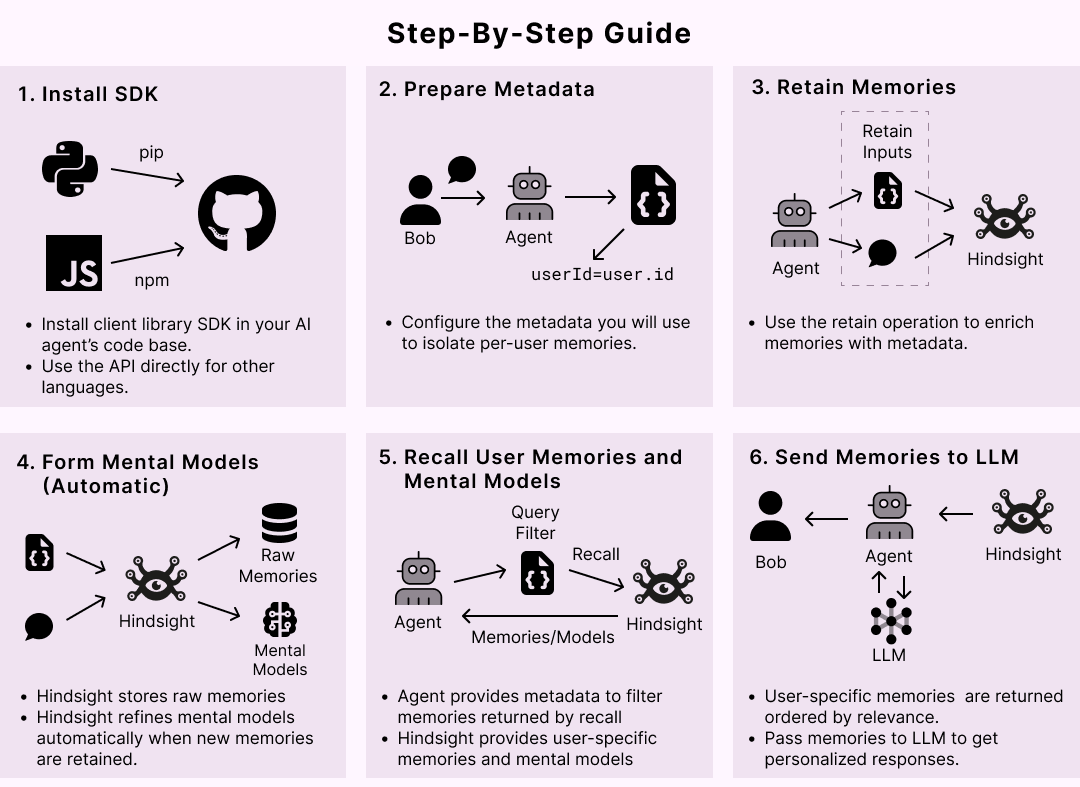
One of the simpler use cases you can use Hindsight for is to personalize AI chatbots and other conversational agents by storing and recalling memories associated with individual users.
The requirements for this use case usually look something like this:

Satisfying these requirements in Hindsight is straightforward. When new user inputs and tool calls are ingested into Hindsight using the retain operation, custom metadata can be used to enrich the new memories. Metadata provides a convenient way to isolate memories that need to be restricted to a given user. Once these are fed into the retain operation, any raw memories and mental models that get created can be filtered when retrieving relevant memories.
Architecture & Operations

Most agent memory implementations rely on basic vector search or sometimes use a knowledge graph. Hindsight uses biomimetic data structures to organize agent memories in a way that is more like how human memory works:
- World: Facts about the world ("The stove gets hot")
- Experiences: Agent's own experiences ("I touched the stove and it really hurt")
- Mental Models: Learned understanding of the agent's world formed by reflecting on raw memories and experiences.
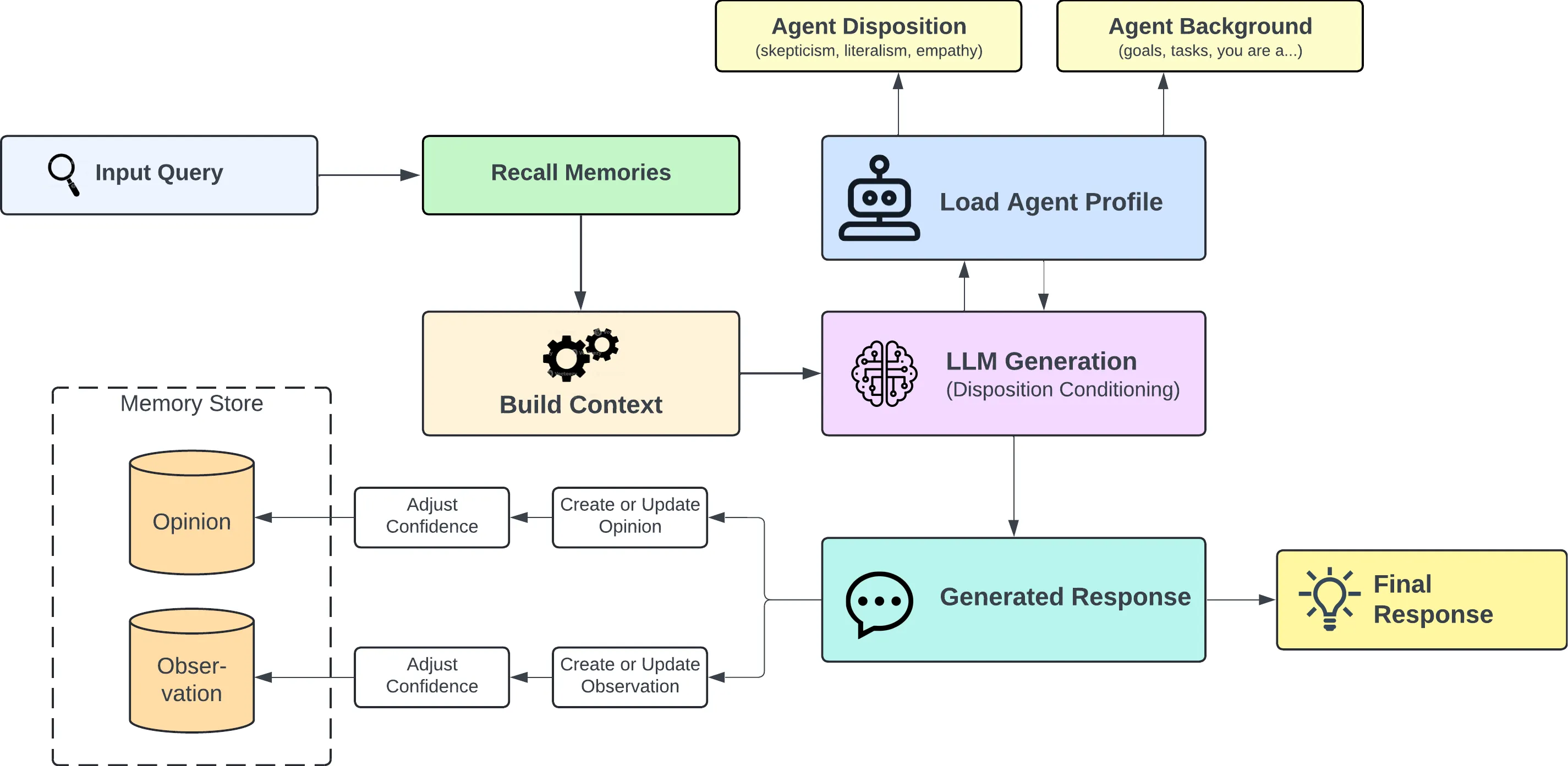
Memories in Hindsight are stored in banks (i.e. memory banks). When memories are added to Hindsight, they are pushed into either the world facts or experiences memory pathway. They are then represented as a combination of entities, relationships, and time series with sparse/dense vector representations to aid in later recall.
Hindsight provides three simple methods to interact with the system:
- Retain: Provide information to Hindsight that you want it to remember
- Recall: Retrieve memories from Hindsight
- Reflect: Reflect on memories and experiences to generate new observations and insights from existing memories.
Retain
The retain operation is used to push new memories into Hindsight. It tells Hindsight to retain the information you pass in as an input.
from hindsight_client import Hindsight

client = Hindsight(base_url="http://localhost:8888")

# Simple
client.retain(
    bank_id="my-bank",
    content="Alice works at Google as a software engineer"
)

# With context and timestamp
client.retain(
    bank_id="my-bank",
    content="Alice got promoted to senior engineer",
    context="career update",
    timestamp="2025-06-15T10:00:00Z"
)
Behind the scenes, the retain operation uses an LLM to extract key facts, temporal data, entities, and relationships. It passes these through a normalization process to transform extracted data into canonical entities, time series, and search indexes along with metadata. These representations create the pathways for accurate memory retrieval in the recall and reflect operations.

Recall
The recall operation is used to retrieve memories. These memories can come from any of the memory types (world, experiences, etc.)
from hindsight_client import Hindsight

client = Hindsight(base_url="http://localhost:8888")

# Simple
client.recall(bank_id="my-bank", query="What does Alice do?")

# Temporal
client.recall(bank_id="my-bank", query="What happened in June?")
Recall performs 4 retrieval strategies in parallel:
- Semantic: Vector similarity
- Keyword: BM25 exact matching
- Graph: Entity/temporal/causal links
- Temporal: Time range filtering

The individual results from the retrievals are merged, then ordered by relevance using reciprocal rank fusion and a cross-encoder reranking model.
The final output is trimmed as needed to fit within the token limit.
Reflect
The reflect operation is used to perform a more thorough analysis of existing memories. This allows the agent to form new connections between memories and build a more thorough understanding of its world.
For example, the reflect operation can be used to support use cases such as:
- An AI Project Manager reflecting on what risks need to be mitigated on a project.
- A Sales Agent reflecting on why certain outreach messages have gotten responses while others haven't.
- A Support Agent reflecting on opportunities where customers have questions not answered by current product documentation.
The reflect operation can also be used to handle on-demand question answering or analysis which require more deep thinking.
from hindsight_client import Hindsight

client = Hindsight(base_url="http://localhost:8888")

client.reflect(bank_id="my-bank", query="What should I know about Alice?")
Resources
Documentation:
Clients:
Community:
Star History
Contributing
See CONTRIBUTING.md.
License
MIT — see LICENSE
Built by Vectorize.io