 e798979733
* fix: move mental model usage metering into engine for MCP support Mental model validation hooks (validate_mental_model_get, validate_mental_model_refresh) were only called in REST HTTP handlers, not in the engine. MCP tools call engine methods directly, so usage metering was skipped entirely for MCP mental model operations. Moved pre-validation and post-completion hooks into memory_engine.py (matching the retain/recall/reflect pattern) and removed the duplicate code from http.py. Co-Authored-By: Claude Opus 4.6 <noreply@anthropic.com> * fix: remove double validation from create_mental_model and add internal checks - Remove pre-validation from create_mental_model since callers always call submit_async_refresh_mental_model next (which validates), preventing double credit checks - Add is_internal checks to mental model metering validators (matching the existing pattern for recall/reflect) so background worker tasks skip billing Co-Authored-By: Claude Opus 4.6 <noreply@anthropic.com> * fix: prevent 307 redirect on /mcp that breaks MCP tool discovery Starlette's Mount class redirects /mcp to /mcp/ with a 307 Temporary Redirect. Many MCP clients don't follow POST redirects, which causes tool discovery to fail (0 tools discovered despite successful auth). Add _MCPPathRewriteMiddleware that rewrites /mcp to /mcp/ at the ASGI level before routing, preventing the redirect entirely. Both /mcp and /mcp/ now work identically. Add regression test test_mcp_no_trailing_slash_works to verify URLs with and without trailing slashes discover tools correctly. Co-Authored-By: Claude Opus 4.6 <noreply@anthropic.com> * harden MCP server for real-world usage - Remove MCP_ENDPOINTS blocklist so banks named "sse"/"messages" route correctly - Scope SSE body rewriting to text/event-stream responses only to prevent data corruption - Add _validate_mental_model_inputs for name, source_query, max_tokens validation in MCP tools - Improve "not found" error messages to include bank_id context - Fix fragile tool count assertions (exact → minimum bounds) - Add integration tests: tool execution, input validation, edge-case bank names - Add unit tests for validation helper and tool-level validation Co-Authored-By: Claude Opus 4.6 <noreply@anthropic.com> * refactor: replace Mount + rewrite middleware with wrapping middleware Starlette's Mount class redirects /mcp -> /mcp/ with 307, which MCP clients don't follow. Previously we patched this with _MCPPathRewriteMiddleware. Now MCPMiddleware wraps the FastAPI app directly via add_middleware, intercepting /mcp* requests before they reach Starlette's router. No Mount means no redirect. - Remove _MCPPathRewriteMiddleware (no longer needed) - Remove app.mount() call - Add prefix parameter to MCPMiddleware - Use app.add_middleware() for proper Starlette integration - Simplify path stripping (just remove prefix, no mount/root_path handling) - Update routing test to match current behavior (no MCP_ENDPOINTS blocklist) Co-Authored-By: Claude Opus 4.6 <noreply@anthropic.com> * fix: update stale docstring referencing removed _MCPPathRewriteMiddleware Co-Authored-By: Claude Opus 4.6 <noreply@anthropic.com> --------- Co-authored-by: Claude Opus 4.6 <noreply@anthropic.com> |
||
|---|---|---|
| .githooks | ||
| .github | ||
| cookbook | ||
| docker | ||
| helm/hindsight | ||
| hindsight | ||
| hindsight-api | ||
| hindsight-cli | ||
| hindsight-clients | ||
| hindsight-control-plane | ||
| hindsight-dev | ||
| hindsight-docs | ||
| hindsight-embed | ||
| hindsight-integration-tests | ||
| hindsight-integrations | ||
| monitoring/grafana/dashboards | ||
| scripts | ||
| skills | ||
| .dockerignore | ||
| .env.example | ||
| .gitignore | ||
| .python-version | ||
| .sesskey | ||
| AGENTS.md | ||
| CLAUDE.md | ||
| CODE_OF_CONDUCT.md | ||
| CONTRIBUTING.md | ||
| hindsight-favicon.png | ||
| LICENSE | ||
| package-lock.json | ||
| package.json | ||
| pyproject.toml | ||
| README.md | ||
| SECURITY.md | ||
| uv.lock | ||







What is Hindsight?
Hindsight™ is an agent memory system built to create smarter agents that learn over time. Most agent memory systems focus on recalling conversation history. Hindsight is focused on making agents that learn, not just remember.
It eliminates the shortcomings of alternative techniques such as RAG and knowledge graph and delivers state-of-the-art performance on long term memory tasks.
Memory Performance & Accuracy
Hindsight is the most accurate agent memory system ever tested according to benchmark performance. It has achieved state-of-the-art performance on the LongMemEval benchmark, widely used to assess memory system performance across a variety of conversational AI scenarios. The current reported performance of Hindsight and other agent memory solutions as of January 2026 is shown here:

The benchmark performance data for Hindsight has been independently reproduced by research collaborators at the Virginia Tech Sanghani Center for Artificial Intelligence and Data Analytics and The Washington Post. Other scores are self-reported by software vendors.
Hindsight is being used in production at Fortune 500 enterprises and by a growing number of AI startups.
Adding Hindsight to Your AI Agents
The easiest way use Hindsight with an existing agent is with the LLM Wrapper. You can add memory to your agent with 2 lines of code. That will swap your current LLM client out with the Hindsight wrapper. After that, memories will be stored and retrieved automatically as you make LLM calls.
If you need more control over how and when your agent stores and recalls memories, there's also a simple API you can integrate with using the SDKs or directly via HTTP.

🤖 Using a coding agent? Install the Hindsight documentation skill for instant access to docs while you code:
npx skills add https://github.com/vectorize-io/hindsight --skill hindsight-docsWorks with Claude Code, Cursor, and other AI coding assistants.
Quick Start
Docker (recommended)
export OPENAI_API_KEY=sk-xxx

docker run --rm -it --pull always -p 8888:8888 -p 9999:9999 \
  -e HINDSIGHT_API_LLM_API_KEY=$OPENAI_API_KEY \
  -v $HOME/.hindsight-docker:/home/hindsight/.pg0 \
  ghcr.io/vectorize-io/hindsight:latest
You can modify the LLM provider by setting HINDSIGHT_API_LLM_PROVIDER. Valid options are openai, anthropic, gemini, groq, ollama, and lmstudio. The documentation provides more details on supported models.
Docker (external PostgreSQL)
export OPENAI_API_KEY=sk-xxx
export HINDSIGHT_DB_PASSWORD=choose-a-password
cd docker/docker-compose
docker compose up
Client
pip install hindsight-client -U
# or
npm install @vectorize-io/hindsight-client
Python
from hindsight_client import Hindsight

client = Hindsight(base_url="http://localhost:8888")

# Retain: Store information
client.retain(bank_id="my-bank", content="Alice works at Google as a software engineer")

# Recall: Search memories
client.recall(bank_id="my-bank", query="What does Alice do?")

# Reflect: Generate disposition-aware response
client.reflect(bank_id="my-bank", query="Tell me about Alice")
Node.js / TypeScript
npm install @vectorize-io/hindsight-client
const { HindsightClient } = require('@vectorize-io/hindsight-client');

const main = async () => {
  const client = new HindsightClient({ baseUrl: 'http://localhost:8888' });

  await client.retain('my-bank', 'Alice loves hiking in Yosemite');

  const results = await client.recall('my-bank', 'What does Alice like?');
  console.log(results);
}

main();
Python Embedded (no server required)
pip install hindsight-all -U
import os
from hindsight import HindsightServer, HindsightClient

with HindsightServer(
    llm_provider="openai",
    llm_model="gpt-5-mini",
    llm_api_key=os.environ["OPENAI_API_KEY"]
) as server:
    client = HindsightClient(base_url=server.url)
    client.retain(bank_id="my-bank", content="Alice works at Google")
    results = client.recall(bank_id="my-bank", query="Where does Alice work?")
Use Cases
Hindsight is built to support conversational AI agents as well as agents that are intended to perform tasks autonomously. The ideal use case for Hindsight are agents that require a blend of these features such as AI employees that need to handle open-ended tasks, change behavior based on user feedback, and learn to perform complex tasks to automate work at a level that approximates a human work. Hindsight can be used with simple AI workflows like those built with n8n and other similar tools, but may be overkill for such applications.
Per-User Memories and Chat History
One of the simpler use cases you can use Hindsight for is to personalize AI chatbots and other conversational agents by storing and recalling memories associated with individual users.
The requirements for this use case usually look something like this:

Satisfying these requirements in Hindsight is straightforward. When new user inputs and tool calls are ingested into Hindsight using the retain operation, custom metadata can be used to enrich the new memories. Metadata provides a convenient way to isolate memories that need to be restricted to a given user. Once these are fed into the retain operation, any raw memories and mental models that get created can be filtered when retrieving relevant memories.

Architecture & Operations

Most agent memory implementation rely on basic vector search or sometimes use a knowledge graph. Hindsight uses biomimetic data structures to organize agent memories in a way that is more like how human memory works:
- World: Facts about the world ("The stove gets hot")
- Experiences: Agent's own experiences ("I touched the stove and it really hurt")
- Mental Models: Learned understanding of the agent's world formed by reflecting on raw memories and experiences.
Memories in Hindsight are stored in banks (i.e. memory banks). When memories are added to Hindsight, they are pushed into either the world facts or experiences memory pathway. They are then represented as a combination of entities, relationships, and time series with sparse/dense vector representations to aid in later recall.
Hindsight provides three simple methods to interact with the system:
- Retain: Provide information to Hindsight that you want it to remember
- Recall: Retrieve memories from Hindsight
- Reflect: Reflect on memories and experiences to generate new observations and insights from existing memories.
Retain
The retain operation is used to push new memories into Hindsight. It tells Hindsight to retain the information you pass in as an input.
from hindsight_client import Hindsight

client = Hindsight(base_url="http://localhost:8888")

# Simple
client.retain(
    bank_id="my-bank",
    content="Alice works at Google as a software engineer"
)

# With context and timestamp
client.retain(
    bank_id="my-bank",
    content="Alice got promoted to senior engineer",
    context="career update",
    timestamp="2025-06-15T10:00:00Z"
)
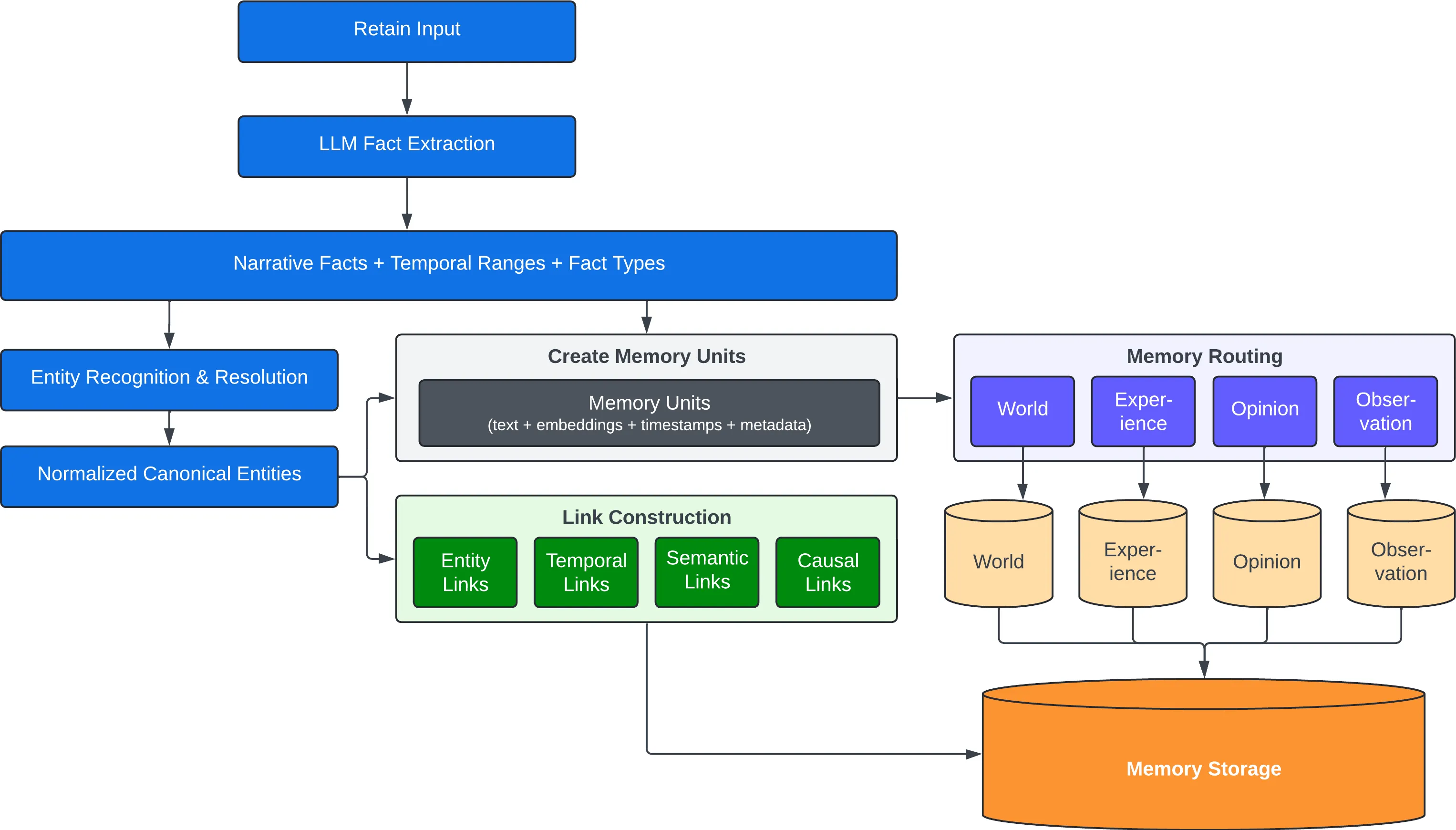
Behind the scenes, the retain operation uses an LLM to extract key facts, temporal data, entities, and relationships. It passes these through a normalization process to transform extracted data into canonical entities, time series, and search indexes along with metadata. These representations create the pathways for accurate memory retrieval in the recall and reflect operations.
Recall
The recall operation is used to retrieve memories. These memories can come from any of the memory types (world, experiences, etc.)
from hindsight_client import Hindsight

client = Hindsight(base_url="http://localhost:8888")

# Simple
client.recall(bank_id="my-bank", query="What does Alice do?")

# Temporal
client.recall(bank_id="my-bank", query="What happened in June?")
Recall performs 4 retrieval strategies in parallel:
- Semantic: Vector similarity
- Keyword: BM25 exact matching
- Graph: Entity/temporal/causal links
- Temporal: Time range filtering
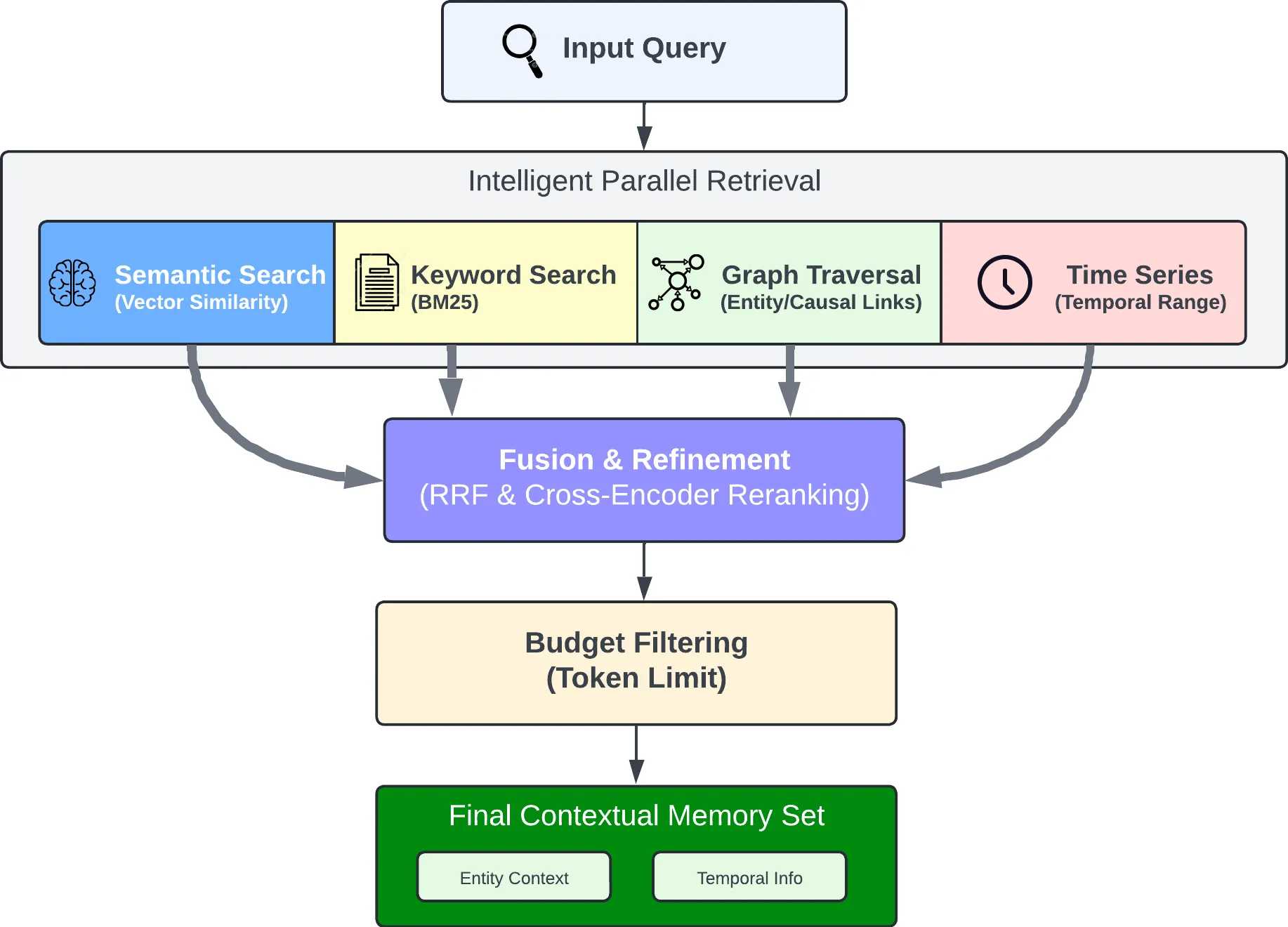
The individual results from the retrievals are merged, then ordered by relevance using reciprocal rank fusion and a cross-encoder reranking model.
The final output is trimmed as needed to fit within the token limit.
Reflect
The reflect operation is used to perform a more thorough analysis of existing memories. This allows the agent to form new connections between memories and build a more thorough understanding of its world.
For example, the reflect operation can be used to support use cases such as:
- An AI Project Manager reflecting on what risks need to be mitigated on a project.
- A Sales Agent reflecting on why certain outreach messages have gotten responses while others haven't.
- A Support Agent reflecting on opportunities where customers have questions not answered by current product documentation.
The reflect operation can also be used to handle on-demand question answering or analysis which require more deep thinking.
from hindsight_client import Hindsight

client = Hindsight(base_url="http://localhost:8888")

client.reflect(bank_id="my-bank", query="What should I know about Alice?")

Resources
Documentation:
Clients:
Community:
Star History
Contributing
See CONTRIBUTING.md.
License
MIT — see LICENSE
Built by Vectorize.io